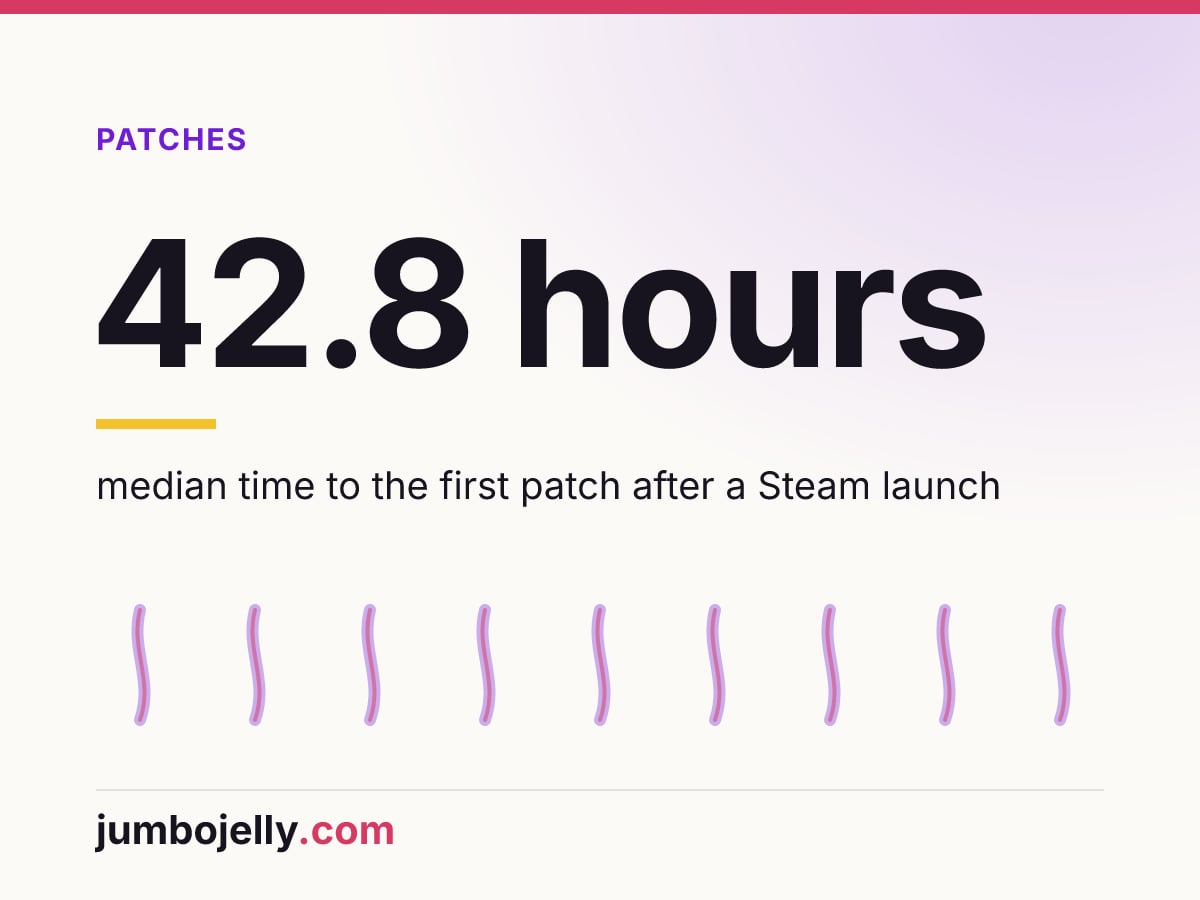
A day one patch is normal on Steam: 22.1% of the 592 games released in September 2026 with at least 10 early reviews announced a patch within 24 hours of release, 73.3% within 7 days and 84.6% within 30 days. The median patched game posted its first fix 42.8 hours after launch and 3 patch announcements in its first month. Below is the timing by genre, size and Early Access status.
How many Steam launches patch in the first day, week and month?
The numbers come from the Steam Launch Bug Index, edition October 2026, which reads the community announcements of every September 2026 release with at least 10 English reviews in its first 14 days (Steam launches in numbers, computed 27 October 2026). The patch day QA checklist is the practical side of the same data: 34 checks to run before a Steam update goes live, with ticks saved in your browser.
| Window after release | Share of launches with a patch announcement | n |
|---|---|---|
| Within 24 hours | 22.1% | 592 |
| Within 7 days | 73.3% | 592 |
| Within 30 days | 84.6% | 592 |
| Median time to first patch (patched games only) | 42.8 hours | 501 |
| Median number of patch announcements in 30 days | 3 | 592 |
The gap between the first-day and first-week numbers is the interesting one. Half of all launches announce their first patch between day 2 and day 7, which is when the first wave of reviews on players’ hardware has arrived and been read. That is the window a one-day Smoke Test is built for: one tester, 8 hours on the patch build before it goes to the default branch, a prioritized report in 2 business days.
Which genres patch fastest?
Simulation and Sports launches are the most likely to patch within a day (31.0% and 31.8%), and Simulation also leads in bug mentions (median 8.2% of early reviews), so the two go together. Free To Play launches patch least: 9.1% within a day and 56.4% within a week.
| Genre | n | Patch within 24 h | Patch within 7 days | Median bug mentions in early reviews |
|---|---|---|---|---|
| Sports | 22 | 31.8% | 77.3% | 7.2% |
| Simulation | 239 | 31.0% | 84.9% | 8.2% |
| Strategy | 148 | 24.3% | 80.4% | 6.3% |
| Casual | 245 | 23.7% | 70.2% | 5.3% |
| Adventure | 214 | 23.4% | 72.4% | 6.5% |
| Indie | 417 | 22.5% | 74.6% | 6.2% |
| Massively Multiplayer | 19 | 21.1% | 63.2% | 5.0% |
| RPG | 134 | 20.9% | 80.6% | 7.1% |
| Action | 206 | 20.4% | 69.9% | 7.3% |
| Racing | 15 | 20.0% | 66.7% | 7.7% |
| Free To Play | 55 | 9.1% | 56.4% | 6.7% |
Genres overlap (a game counts in every tag it carries) and the small rows, Racing, Massively Multiplayer and Sports, will move between editions.
Do Early Access launches patch more?
Yes. Early Access launches announce a first patch within 24 hours at 32.5% against 20.4% for full releases, and 83.1% of them patch within a week. Their early reviews also mention bugs almost twice as often (median 11.1% vs 5.9%). Early Access players sign up for an unfinished game, report what breaks and keep playing; fast patches are the deal. The format’s rules and a launch checklist are in Early Access launch checklist: 35 checks before Steam.
| Group | n | Patch within 24 h | Patch within 7 days | Median bug mentions |
|---|---|---|---|---|
| Early Access | 83 | 32.5% | 83.1% | 11.1% |
| Full release | 509 | 20.4% | 71.7% | 5.9% |
Does the size of the launch change the timing?
Mid-sized launches (100 to 999 reviews) patch fastest: 32.3% within a day and a median first patch at 37.3 hours. Large launches (1,000 reviews and more) are the slowest at a median of 62.2 hours, which fits a bigger team with a release process and a certification-style gate before any build goes out. Small launches sit in between at 43.2 hours, with the lowest first-day rate (19.3%).
| Size (total reviews) | n | Patch within 24 h | Patch within 7 days | Median time to first patch |
|---|---|---|---|---|
| Small (10 to 99) | 436 | 19.3% | 69.5% | 43.2 h |
| Mid (100 to 999) | 127 | 32.3% | 85.0% | 37.3 h |
| Large (1,000+) | 29 | 20.7% | 79.3% | 62.2 h |
Do the buggiest launches patch sooner?
They do. The five September launches with the highest share of bug mentions among games with 200 or more reviews all patched within a day: Police Chief Simulator (42.0% of early reviews mention a bug, first patch after 17.0 hours), Wild West Pioneers (35.6%, 11.8 hours), Tiny Eden (33.3%, 22.8 hours), Train Sim World 7 (29.6%, 14.0 hours) and Crimson Moon (27.7%, 22.2 hours). The pattern across the sample is the same: a fast first patch follows a loud first weekend. Counting all patches in the first month gives the same picture: games with more patches have worse early reviews, and the bug rate explains most of the gap (patch count vs Steam reviews). What a fast patch cannot do is remove the reviews already written, which is why the regression pass belongs before release, and the day one patch is for what only players’ hardware reveals.
What do first patches fix?
The announcements are free text, so this part is a reading of the first-patch posts by JJ rather than a count, and it is marked as an editorial observation. The themes that recur, in rough order of frequency: crashes on specific hardware or drivers, settings that do not save or apply, progression blockers and softlocks on the critical path, save and load problems, controller and input prompts, and performance in one or two heavy scenes. Those are the same areas a pre-release pass covers first, and the same blocks the Smoke Test spends its 8 hours on. The next edition will code the first-patch texts into categories so this becomes a table.
How to plan for patch day
- Name the owner. One person who can build, test and push a fix on launch day and the day after, with a backup.
- Keep the rollback ready. Note the live build ID before the patch goes out, so the previous build can be set live in minutes.
- Test the exact build on a beta branch. Not a local build, the one Steam delivers; check the build ID.
- Regression on changed areas and saves. A save from the live build must load in the patch build; players mid-run must not be stuck.
- Read reviews and crash reports on a schedule. Every few hours for the first 48 hours, then daily for a week.
- Write the patch notes plainly. Say what changed, including known issues; the notes are what players quote in reviews.
The full list is the patch day QA checklist. Edition 2 of the index, with October 2026 launches, comes in early November and will show whether the 22% holds.