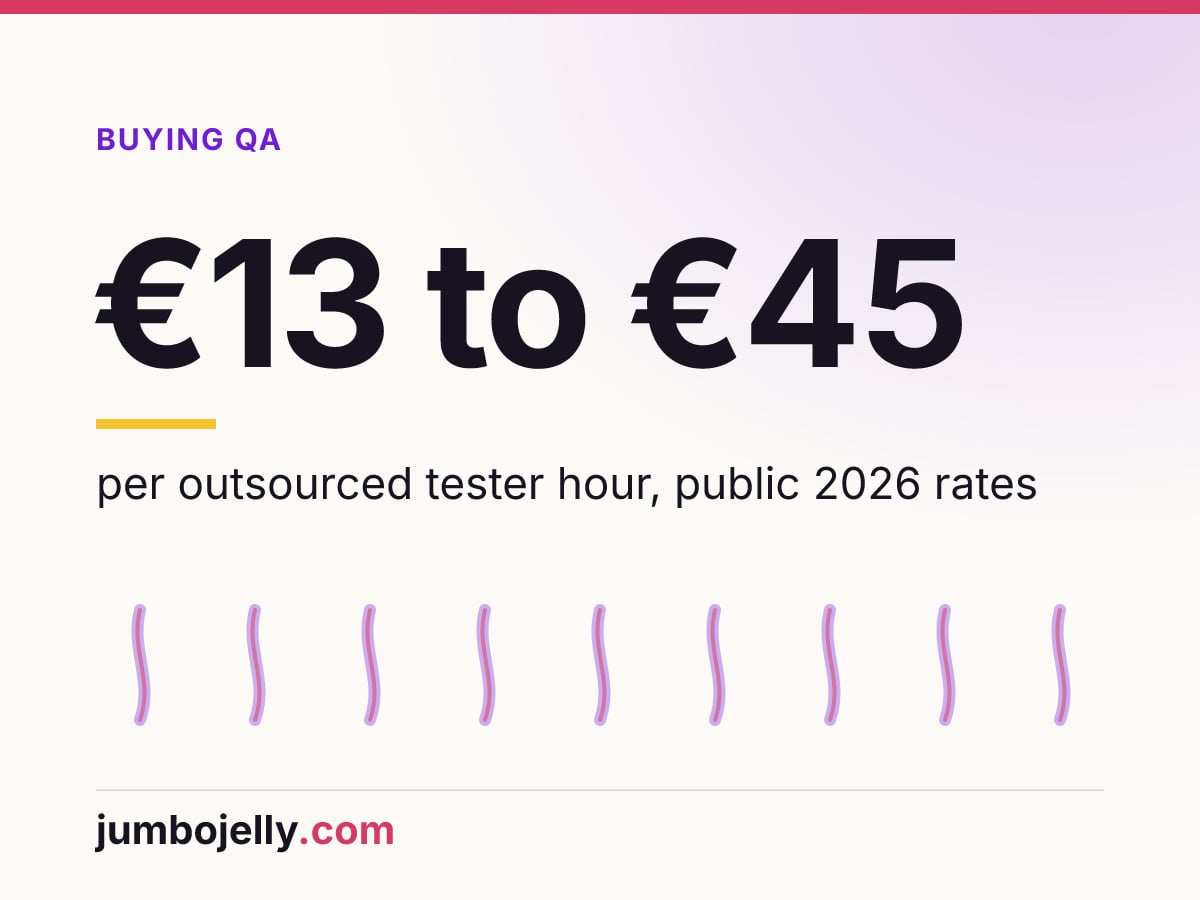
Game QA cost in 2026 starts at about €13 to €45 per outsourced tester hour, based on public rate bands, while US employers pay game testers a median of $17.90 an hour in wages alone. A Next Fest demo usually needs 16 to 30 tester hours and a 1.0 launch 120 to 300, so most indie budgets land between a few hundred and a few thousand euros per milestone.
What does a game QA tester cost per hour in 2026?
Public numbers fall into two groups: what employers pay testers in wages, and what QA vendors bill studios. The second number is always higher, because it covers management, devices, reporting and the vendor’s margin. If you want to turn these rates into a budget for your own build, the QA hours calculator estimates tester hours from your game’s length, platforms and features.
All euro values below use the ECB reference rates of 27 October 2026 (1 EUR = 1.1150 USD, 0.83658 GBP, 4.4020 PLN) (ECB, accessed 27 Oct 2026).
| Market | What the number is | Figure | In euros | Source |
|---|---|---|---|---|
| US | Game tester wage, average | $17.90/h | €16.05/h | Indeed, 65 salaries, updated 9 Oct 2026 (accessed 27 Oct 2026) |
| US | Game tester wage, median (10th to 90th percentile) | $20.00/h ($13 to $35) | €17.94/h | Payscale, 37 profiles, updated 1 Feb 2025 (accessed 27 Oct 2026) |
| UK | Game tester base salary, average | £20,317/yr | €24,286/yr | Payscale UK, 35 profiles, updated 16 Jul 2023 (accessed 27 Oct 2026) |
| Poland | Game tester (“tester gier”) wage, average | 39.71 zł/h | €9.02/h | Jooble, 70 salaries, data from 21 Oct 2026 (accessed 27 Oct 2026) |
| Poland | Manual tester, mid, employment contract, median | 8,300 zł/month gross | €1,885/month | Bulldogjob, survey Jan to Feb 2025 (accessed 27 Oct 2026) |
| Global | Outsourced game QA, vendor band | $15 to $50/h | €13 to €45/h | SnoopGame blog (accessed 27 Oct 2026) |
| Western Europe and North America | Outsourced game QA, vendor band | $35 to $75/h | €31 to €67/h | same source |
| Eastern Europe | Outsourced game QA, vendor band | $15 to $30/h | €13 to €27/h | same source |
Two caveats. Wage data for game testers is thin: the UK contract-rate tracker ITJobsWatch (accessed 27 Oct 2026) has too few quoted rates for a 2025 or 2026 median, so the UK row is salaried pay only. And the vendor bands come from one QA company’s own blog, so they show one seller’s view of the market.
Few vendors publish full price lists. One that does, NipsApp (accessed 27 Oct 2026), lists fixed QA plans at $200, $350, $500 and “from $800”, each bundled with bug fixing.
How many QA hours does a Steam milestone need?
Hours drive the bill more than the rate does. For a demo build or a single patch, a fixed scope is often simpler than counting them: a one-day Smoke Test gives one tester 8 hours on your build for €290, with a prioritized report within 2 working days.
The table below is an editorial estimate by Jumbo Jelly, based on what a typical single-player PC indie game needs per milestone. Use it as a planning range; it is not measured data. Costs use the €13.45 and €44.84 hourly ends of the vendor band above ($15 and $50 at the ECB rate).
| Milestone | Typical scope | Tester hours (editorial estimate) | Cost at €13.45/h | Cost at €44.84/h |
|---|---|---|---|---|
| Next Fest demo | 30 to 60 min demo, 2 to 3 hardware configs, Steam Deck check | 16 to 30 | €215 to €404 | €717 to €1,345 |
| Patch | Regression pass on changed systems, save compatibility | 8 to 16 | €108 to €215 | €359 to €717 |
| Early Access launch | Full playthrough of available content, settings, saves, 3 to 5 configs | 60 to 120 | €807 to €1,614 | €2,690 to €5,381 |
| 1.0 launch | All content, achievements, localization spot checks, two passes on the release candidate | 120 to 300 | €1,614 to €4,035 | €5,381 to €13,452 |
Multiplayer, several languages or a large open world move a game to the top of each range or past it. A 20-minute demo with one language sits at the bottom.
Fixed price, hourly, retainer or in-house: which costs less?
Each billing model fits a different stage. The cheapest per hour is rarely the cheapest per release, because a model that does not match the work adds setup and idle time.
| Model | Public price example | Effective rate | Fits best | Watch out for |
|---|---|---|---|---|
| Fixed-price check | Jumbo Jelly Smoke Test: €290 for 8 h, 1 tester | €36.25/h | Demo, single patch, first outside look at a build | Fixed scope; extra builds mean a new check |
| Fixed-price check, larger | Jumbo Jelly Launch Health Check: €590 for about 30 h of testing by up to 2 testers plus 5 h of Team Lead time | about €16.86/h across 35 h | Early Access or 1.0 release candidate, one-off | One-off, no retainer; a second round is a new order |
| Hourly | $15 to $50/h vendor band (SnoopGame); listed vendors often set a minimum, for example $1,000+ on Clutch (accessed 27 Oct 2026) | €13 to €45/h | Studios with a producer who can scope each round | Minimum project sizes, hours that grow without a cap |
| Monthly retainer | $2,500 to $8,000 per dedicated tester per month (SnoopGame); Jumbo Jelly ongoing QA from about €1,000/month | varies by hours included | Live games with a patch every few weeks | Paying for idle weeks between builds |
| In-house tester (US) | $17.90/h wage (Indeed) × 2,080 h = $37,232/yr; wages are 68.5% of employer costs for full-time private workers (BLS ECEC, June 2026 data, released 9 Sep 2026, accessed 27 Oct 2026) | $54,353/yr total, about $26.13/h (€48,747/yr) | Studios shipping continuously with 15+ developers | Hardware, management time, and a tester who knows the game too well to see it fresh |
The in-house line is a calculation from two public numbers: Indeed’s average wage divided by the BLS share of wages in total employer cost. It excludes test hardware, software licences and recruiting. The BLS figure covers all US private industry, so game studios with richer benefits will pay more.
A full-time hire pays off when the work is steady. One tester at 2,080 hours a year covers the hours of roughly seven to seventeen 1.0 launches from the estimate table above, which few indie studios ship in a year. For most teams under 30 people, a mix works better: fixed checks before dates, hourly rounds during crunch.
What does skipping QA cost after launch?
The visible cost is the day-one patch. The less visible one is the review score, because Steam uses it in store visibility. Valve has said that games get a store “boost” based on their review bucket, and that a Mixed game receives over 500% more boost than a Mostly Negative one, as quoted by PCGamesN (19 May 2019, accessed 27 Oct 2026). The boost is roughly flat from Mixed upward and drops sharply below 40% positive.
Older public data points the same way. An Ars Technica Steam Gauge analysis summarized by Game Developer (April 2014, accessed 27 Oct 2026) found the median game scoring 90 to 100 on Metacritic sold about 50 times as well as the median game below 30. The same analysis called the middle of the range too erratic for firm conclusions, so use it to judge direction only.
Our own launch data points the same way: of 592 Steam games released in September 2026 with at least 10 early reviews, 22.1% announced a patch within 24 hours and 73.3% within a week (Steam launches in numbers, Steam Launch Bug Index, October 2026 edition, computed 27 October 2026). A patch that was not planned is developer time that was not budgeted.
A practical way to frame the risk: compare one QA round to one week of your team’s salaries spent on emergency patches, plus refunds from players who hit a crash in the first two hours of play.
Three questions that lower your QA quote
Most of a QA quote is uncertainty. Answer these three before you ask for a price, and both fixed and hourly quotes come down.
- What exactly is in scope? Name the content (levels, modes, languages), the hardware (minimum spec, Steam Deck, controllers) and what is out of scope. A tester who knows to skip the unfinished chapter 4 saves you hours of duplicate reports.
- Which build, and is it stable? Give one build ID on a dedicated Steam branch and freeze it for the test window. Swapping builds mid-round resets progress and turns exploration into re-checking.
- What does the report need to contain? Agree on severity levels, repro steps, video and where bugs land (a sheet, Jira, Notion). A clear format cuts the Team Lead’s write-up time, which is part of every quote.
All three fit on one page. Our guide on how to write a QA brief has a template with the fields testers ask for first.