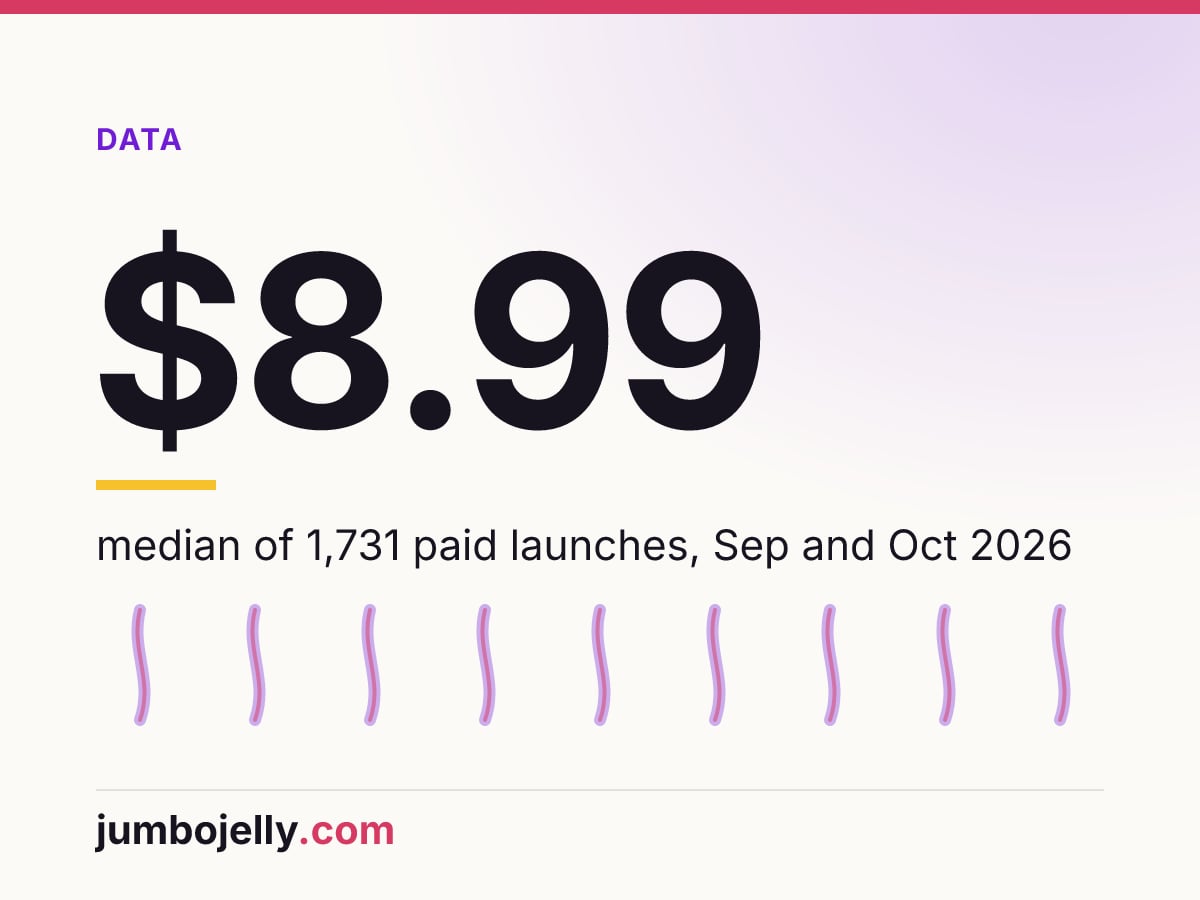
The median paid Steam game released in September or October 2026 listed at $8.99 in the US store on 12 November, across 1,731 paid titles among 2,019 launches with at least 10 reviews. Half of them sit between $4.99 and $14.99, and 94.6% end in .99. Launches priced higher drew more bug words in their first 14 days of reviews.
Price also tracks review volume: across all 4,752 launches from 1 September to 20 October, first-month review counts by price rise from a median of 1 under $5 to 149 at $20 to $29.99.
What price do new Steam games launch at in 2026?
Most of them launch under $10. Of 2,019 games, 287 (14.2%) were free and 1,731 had a US list price. One had neither. The table splits the paid ones into bands, with each month shown on its own.
| US list price | All paid launches (1,731) | September (861) | October (870) |
|---|---|---|---|
| Under $5 | 26.8% | 27.4% | 26.2% |
| $5 to $9.99 | 36.6% | 33.7% | 39.4% |
| $10 to $14.99 | 17.2% | 18.4% | 16.1% |
| $15 to $19.99 | 11.1% | 11.5% | 10.7% |
| $20 to $29.99 | 5.3% | 5.7% | 4.8% |
| $30 or more | 3.1% | 3.4% | 2.8% |
The two months barely differ, which suggests the bands hold from one release calendar to the next. The mean was $11.28, pulled up by a thin top end. The cheapest paid launch cost $0.99 and the most expensive $69.99.
For the review side of the September group, game by game, the Steam launches in numbers page has 923 launches in one CSV, with bug mentions, negative share and patch timing per row.
Which price points do Steam launches pick?
$4.99 and $9.99 lead, and almost nobody uses round numbers. 1,638 of the 1,731 paid launches (94.6%) end in .99. Prices ending in .00 make up 1.6% and .49 another 1.5%.
| Price | Launches | Share of paid |
|---|---|---|
| $4.99 | 211 | 12.2% |
| $9.99 | 191 | 11.0% |
| $14.99 | 137 | 7.9% |
| $5.99 | 130 | 7.5% |
| $7.99 | 129 | 7.5% |
| $19.99 | 122 | 7.0% |
| $6.99 | 95 | 5.5% |
| $2.99 and $3.99 | 77 each | 4.4% each |
| $0.99 | 43 | 2.5% |
The $0.99 group sits on Valve’s floor. Steamworks says a base price must be at least the equivalent of the $0.99 tier.
Published benchmarks tend to sit higher than this list because they start from hit charts. GameDiscoverCo put the median price of the top 50 new paid Steam games by copies sold at $15.64 for October 2025, down from $19.50 in February 2023. In our data, the 410 launches that passed 200 reviews come close to that, with a median of $14.99.
Whatever the price, the first two weeks of reviews judge the build, and the bug section below shows how that played out by band. If you want an outside pass before release, a Launch Health Check gives it up to 2 testers for about 30 hours, with a Team Lead and a ranked report in 3 business days.
Do bigger launches charge more?
Yes, and the step is clear. We split the games by how many reviews they had on 12 November, a rough stand-in for how many people bought them.
| Reviews on 12 Nov 2026 | Launches | Free | Median paid price | Middle half of paid prices |
|---|---|---|---|---|
| 10 to 49 | 1,162 | 17.6% | $6.99 | $4.99 to $9.99 |
| 50 to 199 | 447 | 9.8% | $9.99 | $6.99 to $14.99 |
| 200 or more | 410 | 9.5% | $14.99 | $7.99 to $21.99 |
Across all paid launches, price and review count move together (Spearman rho 0.40). The arrow can run either way. A bigger team can ask more, and a game that sells well collects more reviews. At the top, 12 games with 200 or more reviews charged $59.99 or $69.99, among them Onimusha: Way of the Sword, Gears of War: E-Day and EA SPORTS FC 27.
Early Access launches were not the bargain shelf. The 258 paid ones had a median of $12.99, against $7.99 for full releases, and a third of them (33.3%) sat between $10 and $14.99. Under $5 held 9.7% of Early Access launches and 29.8% of full releases.
Do pricier Steam launches get more bug complaints?
On average, yes. For 1,165 launches released by 28 October with at least 10 English reviews in their first 14 days, we counted the share of reviews that use words like crash, freeze, glitch or broken, the same list as our study of bug words in launch reviews. The share climbs with the price band, and so does the negative share.
| US list price | Launches with 10+ early reviews | Median reviews with bug words | Median negative reviews | Launches with bug words in 20%+ of reviews |
|---|---|---|---|---|
| Under $5 | 202 | 2.95% | 8.25% | 4.5% |
| $5 to $9.99 | 353 | 5.6% | 9.8% | 10.8% |
| $10 to $14.99 | 217 | 6.8% | 10.5% | 18.9% |
| $15 to $19.99 | 139 | 8.3% | 11.0% | 15.1% |
| $20 to $29.99 | 73 | 11.8% | 19.7% | 17.8% |
| $30 or more | 47 | 9.5% | 28.0% | 23.4% |
| Free | 133 | 3.1% | 15.3% | 8.3% |
The rank correlation across 1,031 paid launches is 0.28 for bug words and 0.17 for negative share, both well clear of chance in a permutation test. Each month shows the same climb: bug words in 3.0% of reviews under $5 against 13.2% at $20 to $29.99 in September, and 2.8% against 9.9% in October. Among launches with 200 or more reviews the correlation is 0.35.
Price travels with other things: bigger 3D games with more systems, more varied hardware among buyers, and players who expect more after paying $30. A $3 game with one screen has fewer places to crash. Some reviewers also write “broken” when they mean poor value, and a word list cannot tell those apart. So the table describes autumn 2026 launches. It is not a rule about how players judge bugs.
What does the price change for a launch build?
It fixes one variable for the first month. Valve asks developers to wait until 30 days after release before changing the price, apart from fixing a pricing error. Discounts follow the same clock: a launch discount can start on release day, and the next one has to wait 30 days. On 12 November, 10.3% of the paid launches in our set showed a discount.
So in the first 14 days, when the review score forms, the price is set and the build is the part a team can still change. Three things follow for test planning:
- Plan coverage by what the band shows. At $20 and up, about one launch in five had bug words in a fifth or more of its early reviews. Under $5 it was one in 22.
- Test the first two hours hard. Valve takes refund requests within two weeks of purchase and under two hours of playtime, so that window carries most of the refund risk. Our note on the 2-hour refund rule lists what a launch build has to survive in it.
- Keep revenue math separate. What a $14.99 price means after Valve’s share, regional pricing, VAT, refunds and the $100 Steam Direct fee is a different question. The Steam revenue calculator runs it with sourced defaults.
How far can these numbers be trusted?
The price is the US list price on 12 November 2026, before any discount, from the price_overview field of Steam’s public appdetails endpoint. For games released after 13 October, Valve’s 30-day rule makes it very likely the launch price. A September game could have changed its price since. The two months show almost the same bands, which helps but proves nothing.
The release date is the one the store shows today. That pulls in 1.0 releases of games that spent years in Early Access, such as Valheim and Enshrouded. 296 games in the set have app IDs below 3,000,000, a rough marker of an older store page. Without them, the median paid price drops from $8.99 to $7.99.
The review side uses English reviews only, from the first 14 days after release, up to 300 per game. Before using the review numbers, we checked the September part against our October 2026 index edition. We got 621 games with a median of 6.3% bug words; the edition, read two weeks earlier, had 592 games and 6.5%. October launches after 28 October are left out of the review tables, since their 14 days had not ended. Games under 200 reviews are counted but not named.