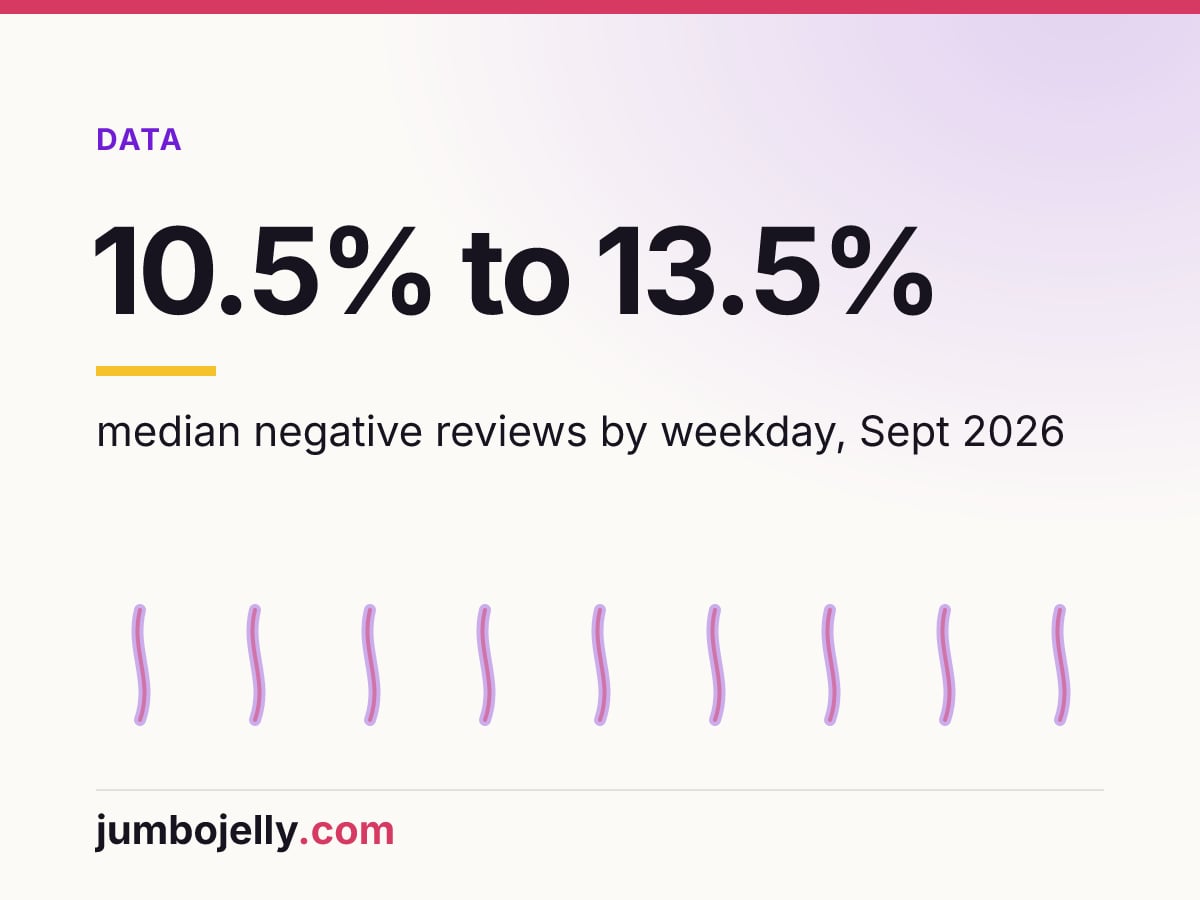
No weekday was clearly the best day to release a game on Steam in September 2026, judged by how launches went. Across 592 launches with 10+ English reviews in 14 days, the median negative share ran from 10.5% to 13.5%, lowest for Tuesday and highest for the weekend. That 3-point spread is the size random day labels produce, and the day ranking flips between small and larger games.
Which release day had the best Steam reviews in September 2026?
The numbers come from the October 2026 edition of the Steam Launch Bug Index. It reads every September 2026 release with at least 10 English reviews in its first 14 days. We took the weekday from the store release date and grouped the 592 games. Saturday and Sunday are merged, since together they hold only 24 games.
| Release day | Launches | Median negative share | 95% interval of that median | Median bug mentions | 30%+ negative | Patch within 24 h |
|---|---|---|---|---|---|---|
| Monday | 92 | 11.6% | 7.6% to 16.7% | 6.3% | 13.0% | 19.6% |
| Tuesday | 133 | 10.5% | 7.4% to 15.3% | 6.5% | 15.8% | 29.3% |
| Wednesday | 118 | 12.3% | 8.3% to 15.7% | 6.6% | 16.9% | 11.9% |
| Thursday | 130 | 11.1% | 8.2% to 15.7% | 6.0% | 16.9% | 20.8% |
| Friday | 95 | 12.3% | 10.7% to 16.7% | 6.9% | 21.1% | 29.5% |
| Weekend | 24 | 13.5% | 6.2% to 25.7% | 10.6% | 16.7% | 20.8% |
| All days | 592 | 11.8% | 10.0% to 13.5% | 6.5% | 16.7% | 22.1% |
Every weekday interval overlaps every other one, so no gap in the table is large next to the uncertainty in the medians. The full edition is on Steam launches in numbers, 923 launches in one CSV with a release date on every row. Add a weekday column and you can check any cell here in a few minutes.
The bug-mention column is the one to watch for launch quality. It moves within 1 point across the five weekdays (6.0% to 6.9%). Once the date is on the store page, the build is the part you can still change. The Smoke Test puts one outside tester on your release candidate for 8 hours. The ranked bug report arrives in 2 business days.
Is the gap between release days bigger than chance?
No. We kept the 592 games and their review numbers fixed and dealt the weekday labels out again at random, 5,000 times. Each deal gives a fake week; the question is how often a fake week shows a gap between its best and worst day as wide as the real one.
| Test (September 2026, 592 launches) | Observed | p (permutation) |
|---|---|---|
| Spread of median negative share across 6 day groups | 3.0 points | 0.961 |
| Spread of median bug mentions across 6 day groups | 4.6 points | 0.092 |
| Spread of 24-hour patch share across 6 day groups | 17.6 points | 0.146 |
| Tuesday vs Friday, median negative share | 10.5% vs 12.3% | 0.412 |
| Tuesday and Thursday vs other days, median negative share | 10.7% vs 12.3% | 0.371 |
| Tuesday and Thursday vs other days, median bug mentions | 6.1% vs 6.8% | 0.486 |
| Weekdays vs weekend, median negative share | 11.8% vs 13.5% | 0.696 |
For negative share, 96% of random relabelings produced a spread at least as wide as the real one. The bug-mention spread comes closer to the usual 5% bar, and almost all of it is the weekend group of 24 games. Among the five weekdays alone, bug mentions sit within a single point.
Most launch-day advice in search results points to Tuesday or Thursday. In this month those two days did slightly better, by 1.6 points of negative share, which is well inside chance. Whatever else a Tuesday or Thursday buys you, such as press coverage or a better slot on the store front, this data does not measure it.
Do bigger launches tell a different story?
They reverse the ranking, which is a strong sign that it is noise. Size here is total reviews at the time of the index: small 10 to 99, mid and large 100 and more.
| Release day | Small launches | Median negative | Mid and large launches | Median negative |
|---|---|---|---|---|
| Monday | 66 | 9.6% | 26 | 15.6% |
| Tuesday | 94 | 7.9% | 39 | 19.7% |
| Wednesday | 85 | 14.3% | 33 | 8.3% |
| Thursday | 92 | 11.1% | 38 | 10.3% |
| Friday | 76 | 13.7% | 19 | 11.5% |
| Weekend | 23 | 13.4% | 1 | (one game) |
Among small games, Tuesday looks best at 7.9% and Wednesday worst at 14.3%. Among the 156 mid and large games, Tuesday is worst at 19.7% and Wednesday best at 8.3%. A real weekday effect would have to push the same way for both groups. Keeping only games with 30 or more early reviews gives the same flip: Tuesday 17.2%, Wednesday 10.0%.
Big releases cluster on two days. Of the 29 launches that passed 1,000 reviews, 12 came out on a Tuesday and 9 on a Thursday; none launched on a Friday or a weekend. The largest by review count was WARDOGS, out on Thursday 10 September. When a handful of big launches share a day, their individual receptions move that day’s median far more than the date itself could.
What happens to games released on a weekend?
Most of them fade before they collect enough reviews to count. Only 58 of the 923 candidate launches (games with 10+ store reviews when the index ran) came out on a Saturday or Sunday. 34 of those 58 (58.6%) gathered fewer than 10 English reviews in their first 14 days and dropped out of the statistics. For weekday launches that share was 34.3% (297 of 865). This is the one day-related gap in the data that clears the chance bar (p = 0.001).
The 24 weekend games that remain are a different population. 23 of 24 are small, a third are free to play (8 games), and a third carry an AI Generated Content Disclosure. On weekdays the free share is 5% to 10%. A weekend game had a median of 21.5 early reviews, so one or two reviews move its negative share by 5 to 10 points. That is why the weekend interval runs from 6.2% to 25.7%.
Two readings fit, and this data cannot separate them. Weekend launches may get less attention, or the teams that pick a weekend may be smaller to begin with. Either way, the weekend row in the first table describes a filtered group.
Which days do studios actually pick?
Thursday, once you count per calendar day. September 2026 began on a Tuesday, so it had five Tuesdays and five Wednesdays but four of every other day. Raw totals flatter Tuesday for that reason.
| Release day | Dates in September 2026 | Candidate launches | Per date | In the statistics |
|---|---|---|---|---|
| Monday | 4 | 140 | 35.0 | 92 |
| Tuesday | 5 | 200 | 40.0 | 133 |
| Wednesday | 5 | 191 | 38.2 | 118 |
| Thursday | 4 | 192 | 48.0 | 130 |
| Friday | 4 | 142 | 35.5 | 95 |
| Saturday | 4 | 26 | 6.5 | 11 |
| Sunday | 4 | 32 | 8.0 | 13 |
The busiest single date was Tuesday 1 September with 54 candidates, followed by Thursday 3 and Thursday 10 September with 50 each. Crowding did not line up with worse reviews either. Games launched on dates above the median of 35 candidates had a median 11.3% negative share; games on quieter dates had 12.7% (p = 0.49). Crowding may still cost visibility and sales, which we do not measure here.
Does the release day change how fast the first patch ships?
It might, and this is the one pattern worth rechecking next month. 29.3% of Tuesday launches and 29.5% of Friday launches posted a patch-like announcement within 24 hours. On Wednesday it was 11.9% (14 of 118 games). Among games that patched at all, the median first announcement came 36.0 hours after a Tuesday release and 57.5 hours after a Wednesday one.
The spread across all six day groups still sits inside chance (p = 0.146), and within 7 days the groups converge at 66% to 79%. A Friday release with a 24-hour patch means a Saturday fix. 9 of the 19 mid and large Friday launches (47.4%) shipped one, a thin cell to read. Our day-one patch data breaks the month’s patch timing down by genre and size. Why more patches tend to follow buggier launches is in patch count vs Steam reviews.
What should decide your Steam release date, then?
Your build, your team and your calendar matter more than the weekday. In September 2026 the spread between weekdays was small next to the spread between buggy and clean launches. Games below the median bug-mention rate of 6.5% had a median 5.7% to 11.1% negative share depending on the day; games above it had 16.0% to 24.2%.
- Pick a day your team can work the next 48 hours. The median first patch announcement this month came 42.8 hours after release. After a Friday launch, that lands on Sunday.
- Avoid a weekend launch unless you have a reason. Weekend games dropped below 10 early reviews far more often in this month.
- Check what else launches that week. Thursday was the busiest launch day in September. The data shows no review penalty for crowding, but your page competes for the same attention. Valve’s sales and fests matter too: our Steam sale and fest calendar lists the last release day that can still discount in each event through July 2027.
- Leave room for Valve’s reviews before the date. Store page and build reviews run on business days, and a rejection adds a round. Our review timeline counts back six weeks from a launch.
- Spend the effort on the build. Across the five weekdays, the median negative share stayed between 10.5% and 12.3%. Split by bugs instead, it was 6.8% for the cleaner half of the month and 18.2% for the buggier half.
A Mixed or worse review score stays on the store page long after launch week. Following the same September launches to 1 November, only 2 of 14 games that opened Mixed climbed out, because across 95 launches with 200+ reviews the first two weeks held 65.8% of all reviews to that date. The month-level medians, genre split and AI disclosure comparison are in the Steam Launch Bug Index for October 2026.
Where do these numbers come from, and where do they stop?
All of it comes from one file: the October 2026 edition of the index, which read Steam store search for September 2026 release dates on 27 October 2026. Of 923 games with 10+ store reviews on that day, 592 had at least 10 English reviews in their first 14 days, and those 592 make up every table here.
The weekday is the release date printed on the store page. Steam shows no hour or time zone there, so a Thursday 10:00 Pacific launch counts as Thursday even though players in Asia saw it on Friday. Review data is up to 300 English reviews per game from Steam’s public endpoint, days 0 to 14; “negative share” is the share marked not recommended, and a review counts as a bug mention if it uses words such as crash, freeze, glitch, stutter, softlock or broken. A patch is a community announcement whose title or first 400 characters mention a patch, fix or update, so a build pushed without a post never shows up. The intervals are bootstrap intervals and the p-values come from the label shuffle described above; both use a fixed seed, so a rerun prints the same figures.
The main limit is that studios pick their own launch day. A team that chooses a Tuesday or a Saturday may differ in size, price model and audience from one that chooses a Thursday, and this split cannot pull those apart from the day itself. It also covers a single month with a single calendar layout. Saturday (11 games) and Sunday (13) are too small to read on their own: apart, they show 25.7% and 13.4% negative, a gap that samples this size throw up all the time. Game names appear only above 200 total reviews, in line with the index rules.
Every table above comes from the public edition file alone, and we will run the same split on October launches. If Wednesday’s slow first patch shows up a second time, it becomes a finding; if not, it goes back to noise.